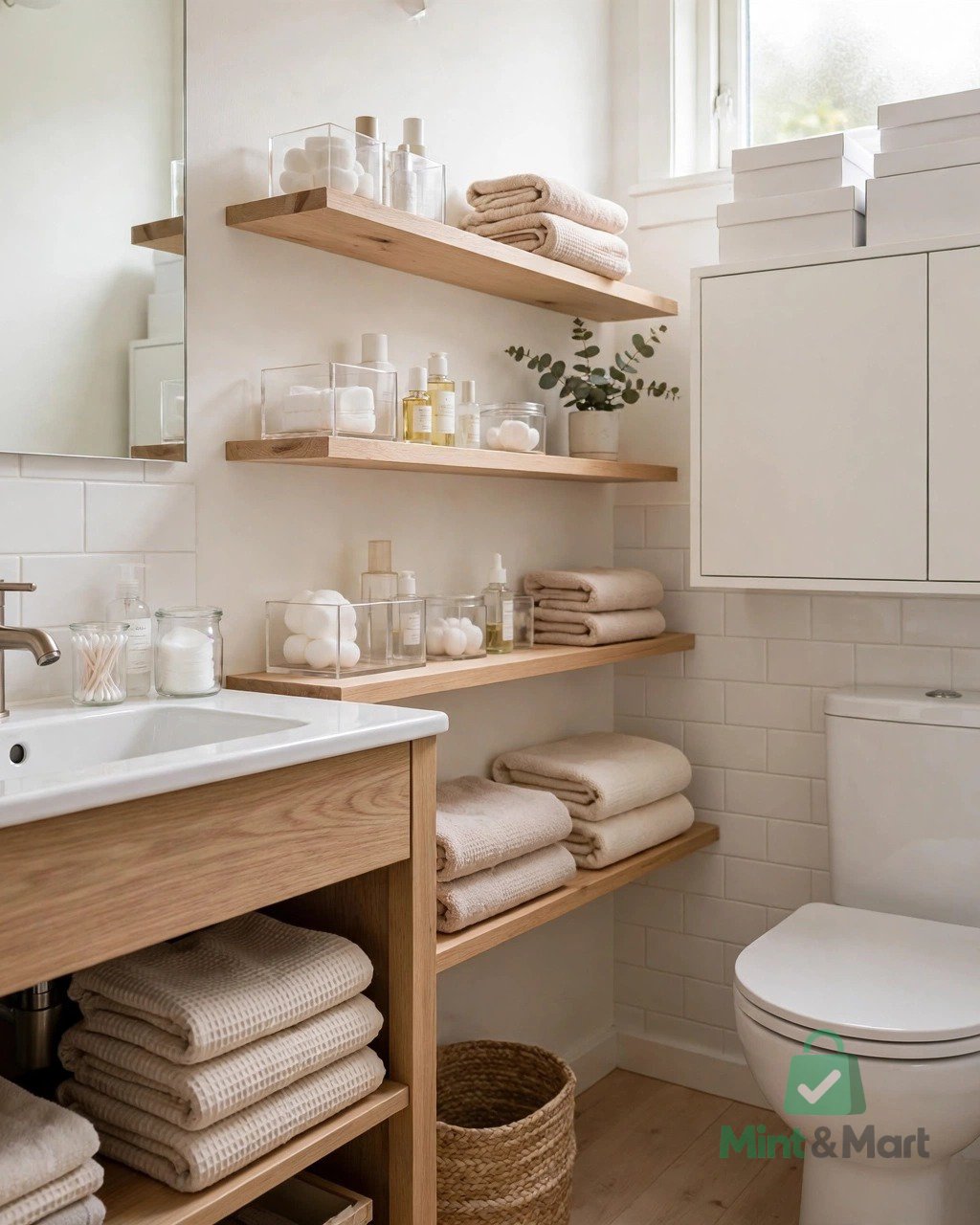
Good bathroom storage is not about fitting the largest possible number of baskets, shelves, and organizers into the room. It is about putting the things you use most often where you can reach them with the least effort.
The simplest approach is to give everyday essentials the easiest-to-reach spaces, move occasional items higher or deeper into cabinets, and keep backups out of prime storage altogether. In a small bathroom, using walls, doors, drawers, and narrow vertical spaces can add useful storage without sacrificing much-needed floor or counter space.
Here are 15 bathroom storage ideas that focus on accessibility, usable space, and less everyday clutter.
Start With the Three-Reach-Zone Rule
Before buying an organizer, divide your bathroom storage into three practical zones.
| Storage zone | What belongs there | Examples |
|---|---|---|
| Daily reach | Things used at least once a day | Toothpaste, skincare, hand towels |
| Easy reach | Things used several times a week | Hair tools, extra towels, cleaning wipes |
| Backstock | Refills and occasional items | Extra soap, unopened toiletries, spare toilet paper |
This one rule can solve a surprising amount of bathroom clutter.
A beautiful shelf will not make a bathroom more functional if you have to move four decorative objects every morning to reach your toothpaste.
1. Use Drawer Dividers for the Things You Reach for Every Morning
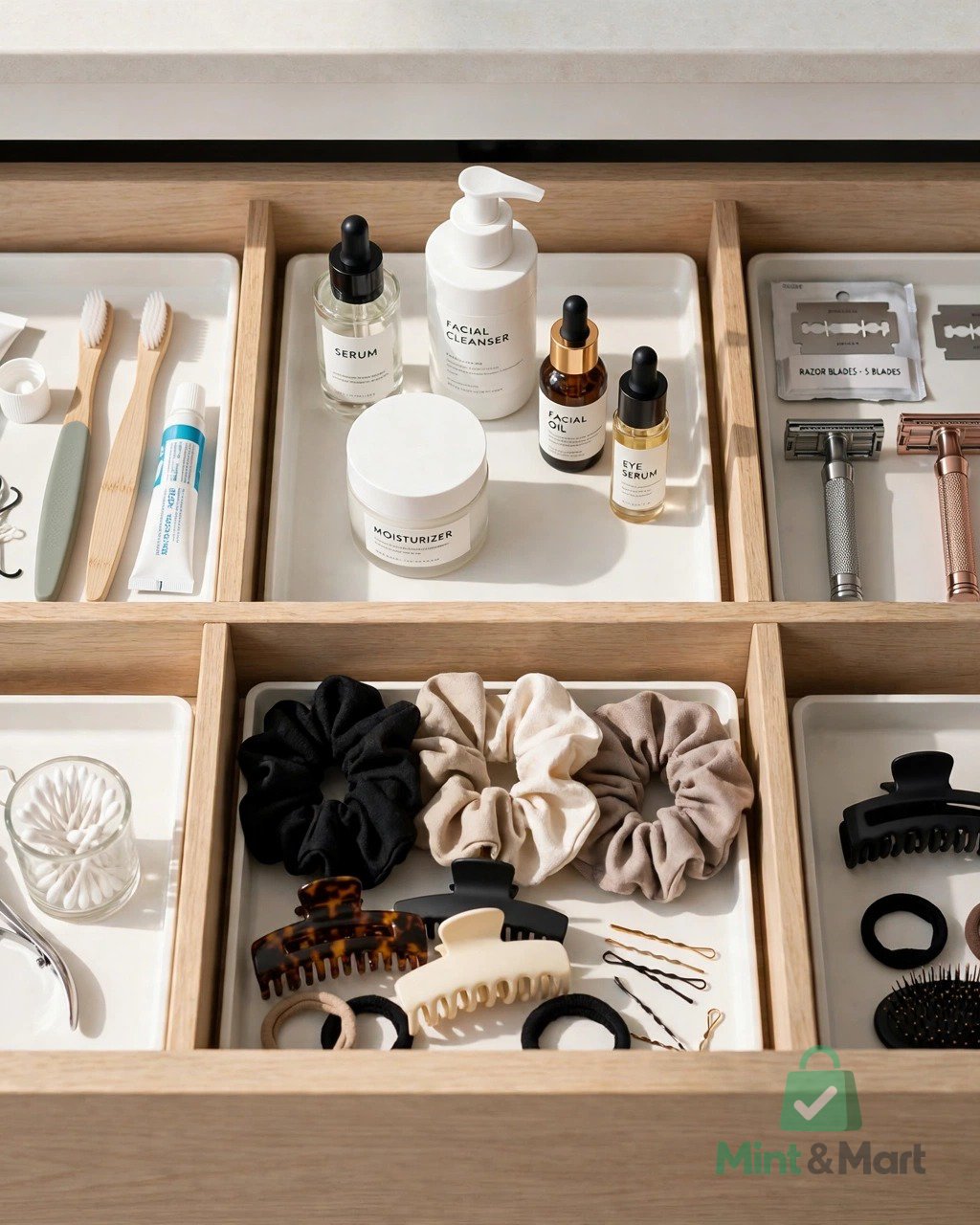
Vanity drawers are often more useful than deep cabinets because you can see everything at once. The problem starts when small items slide together and become one large pile.
Use shallow trays or adjustable dividers to create separate areas for:
- dental care
- skincare
- hair accessories
- razors
- makeup
- grooming tools
Keep the items you use daily in the front half of the drawer.
Best for: Bathrooms with vanity drawers but limited counter space.
What to look for: Adjustable dividers or trays that can be removed and washed.
2. Build Storage Around the Plumbing Under the Sink
Under-sink cabinets often look spacious until the drainpipe takes up the middle.
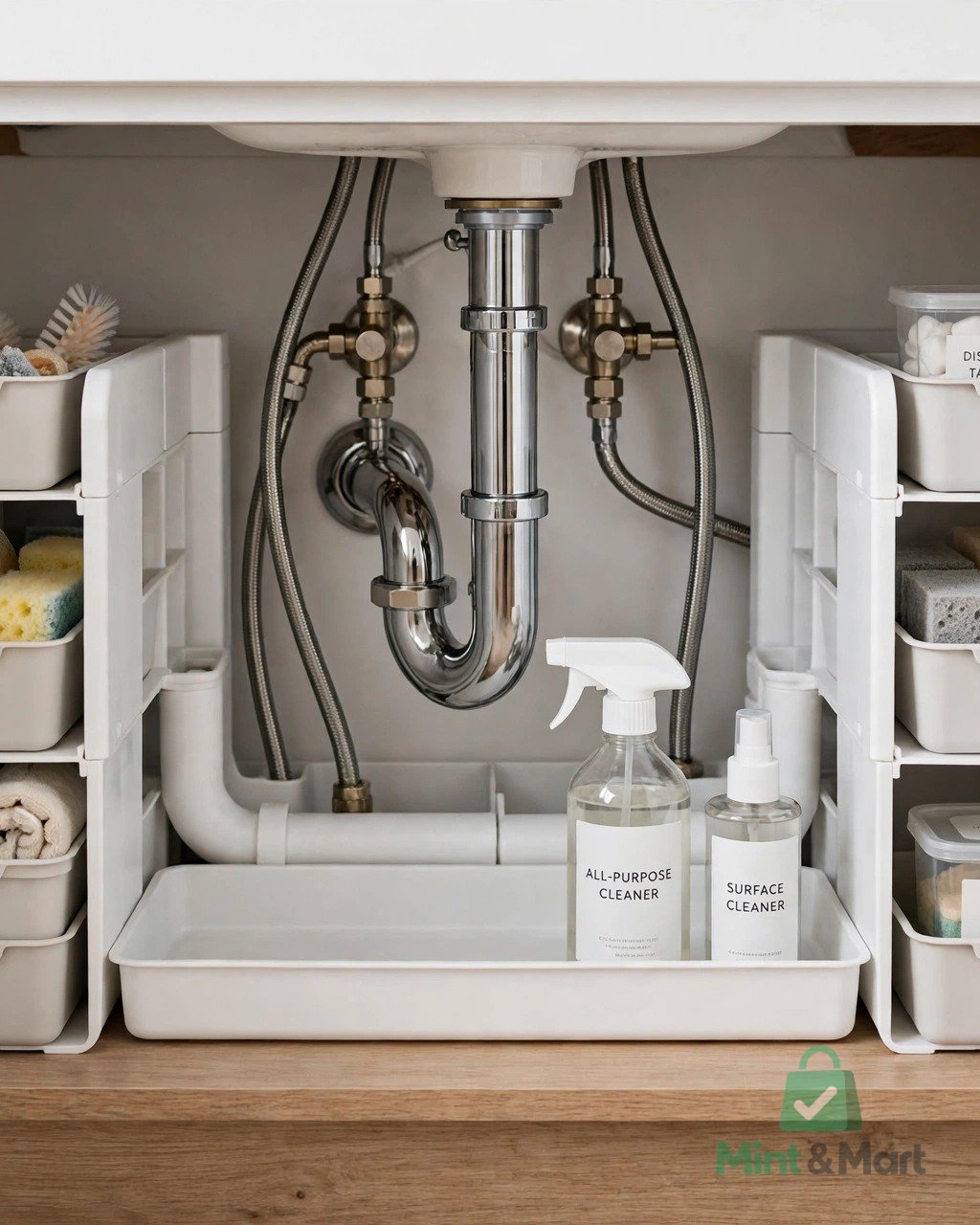
Instead of trying to fit one large organizer underneath it, use smaller storage pieces around the plumbing.
A combination of narrow bins, stackable drawers, or a U-shaped organizer usually makes better use of the available space.
Measure the pipes before buying anything, including their distance from the cabinet floor and doors.
Avoid: Large fixed shelving units that leave unusable gaps around the plumbing.
3. Add Pull-Out Storage to Deep Cabinets
Deep bathroom cabinets provide plenty of volume but poor visibility. Items at the back tend to disappear until they expire or get replaced unnecessarily.
A pull-out bin or sliding organizer brings the back of the cabinet toward you.
Use separate pullouts for categories such as:
- hair care
- body care
- cleaning products
- extra toiletries
Pullouts are particularly useful when several people share one bathroom.
4. Use a Medicine Cabinet for Small Daily Essentials
A mirrored medicine cabinet can turn unused wall depth into highly accessible storage.
It works especially well for small items that otherwise collect around the sink, such as skincare products, toothpaste, floss, razors, and grooming supplies.
If you are remodeling, a recessed cabinet creates storage without projecting far into the room. Surface-mounted versions are easier to add to an existing bathroom.
One caution: medications should be stored according to their label instructions. A warm, humid bathroom may not be an appropriate location for many medicines.
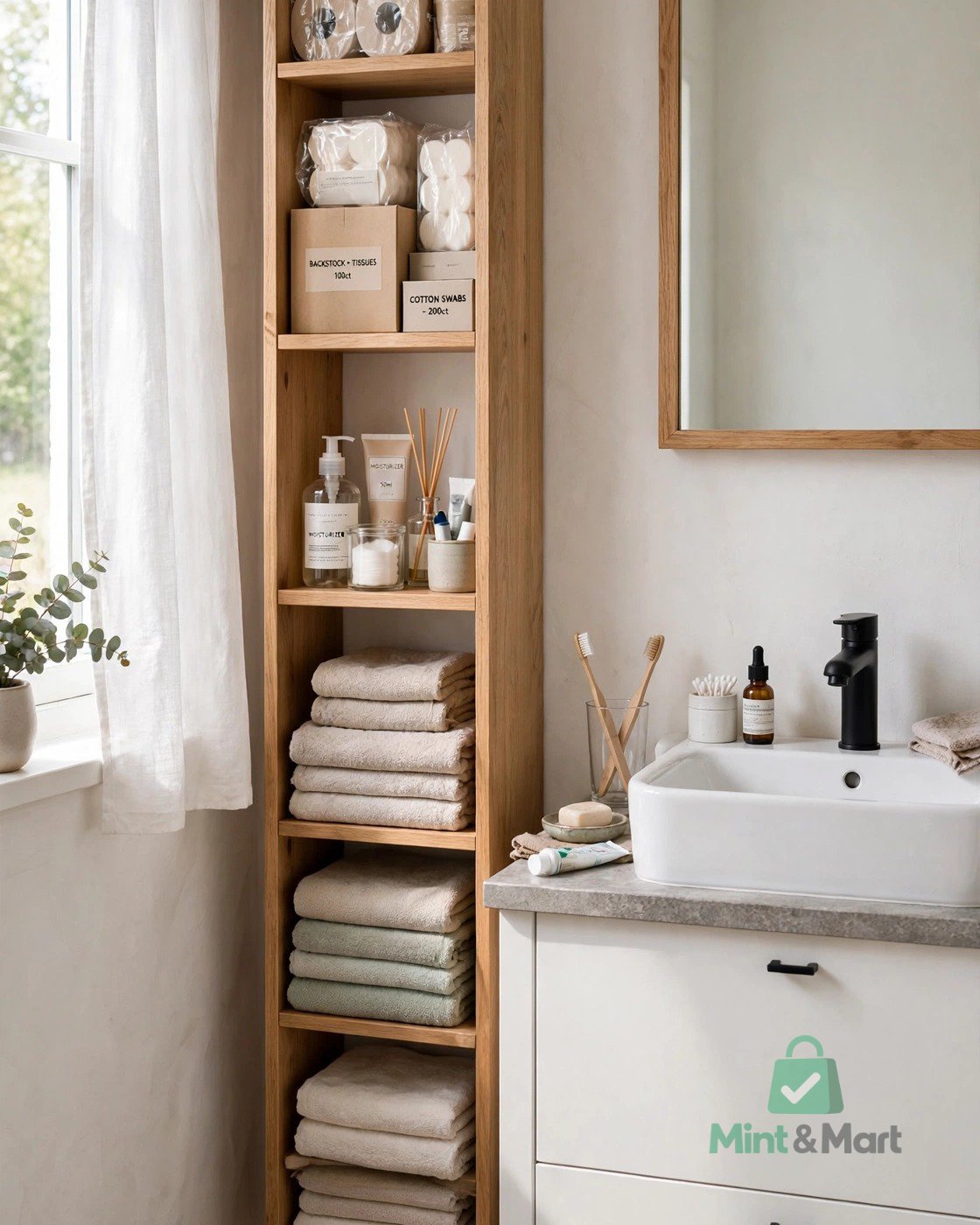
5. Add a Narrow Storage Tower Instead of a Wide Cabinet
When floor or counter width is limited, think vertically.
A narrow tower beside a vanity can hold much more than its footprint suggests. Divide it by frequency of use:
Eye level: Everyday toiletries
Lower shelves: Towels and larger products
Upper shelves: Refills and less frequently used items
Current bathroom-design coverage from Houzz also highlights vertical storage towers and full-height cabinetry as ways to add storage while keeping frequently used products accessible. Houzz
6. Use the Inside of Cabinet Doors
The back of a vanity door is easy to overlook.
Slim adhesive or over-door organizers can hold small lightweight items such as:
- hair brushes
- cleaning cloths
- small bottles
- hair accessories
This works best when the organizer is shallow enough to clear the shelves and plumbing when the cabinet closes.
Before installing anything, close the cabinet and check exactly where the contents will sit.
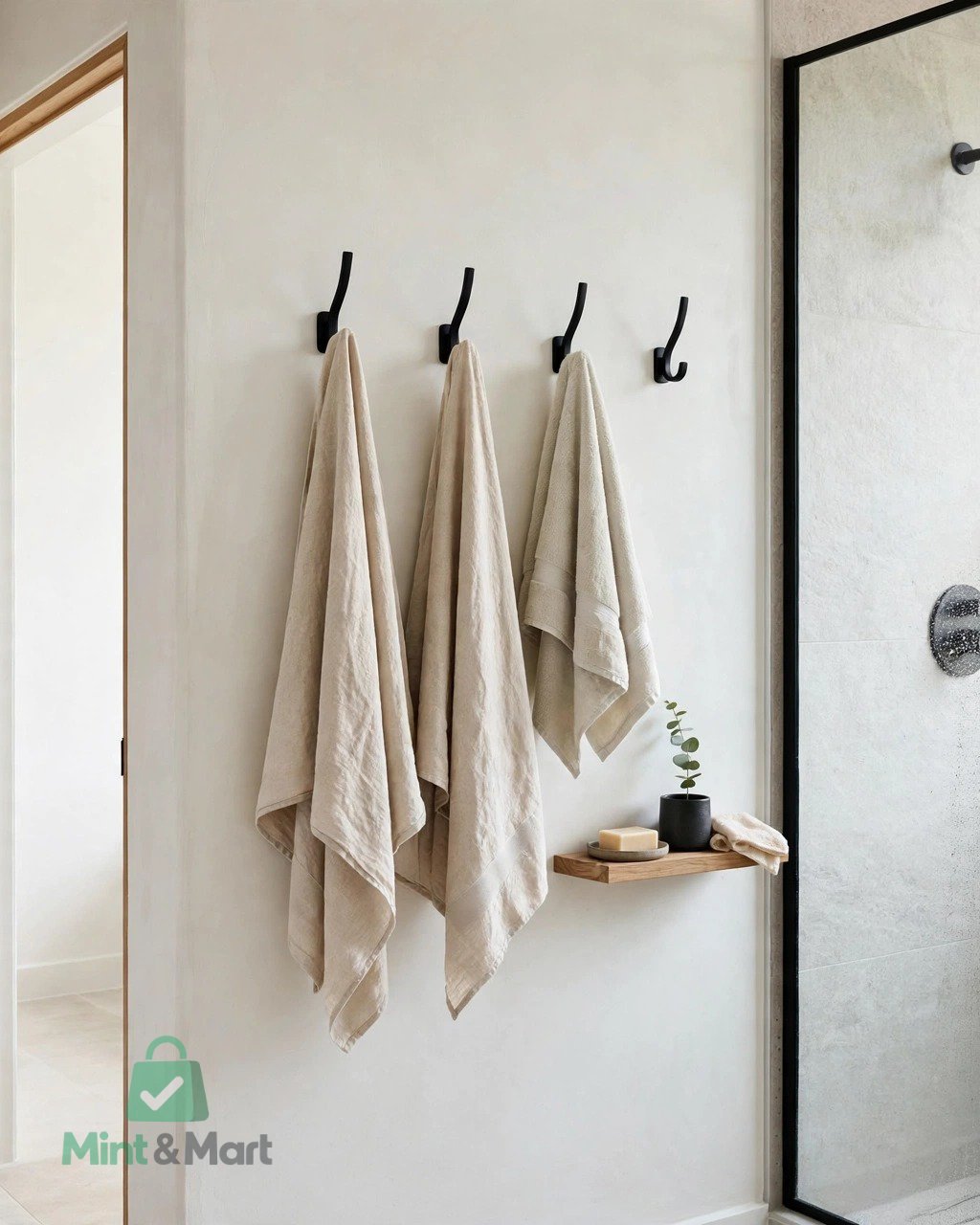
7. Put Hooks Where Towels Are Actually Used
Storage should follow behavior.
If everyone drops towels on a chair or counter because the towel bar is inconvenient, changing the storage location may work better than trying to change the habit.
Place hooks:
- beside the shower
- near the sink
- behind the bathroom door
- beside the bathtub
Hooks use very little wall space and can also handle robes, shower caps, or clothing.
Strategically placed hooks also appear in Houzz’s 2026 bathroom storage examples because they keep towels close to where they’re needed without using cabinet space. Houzz
8. Use the Space Above the Toilet Carefully
The wall above a toilet can provide useful storage, particularly in a small bathroom.
Good options include:
- a shallow wall cabinet
- one or two floating shelves
- a compact over-toilet storage unit
Use this space for extra toilet paper, folded towels, or closed containers of supplies rather than dozens of small loose objects.
Rule of thumb: If storage makes the toilet area feel visually crowded or makes items awkward to reach, you have probably added too much.
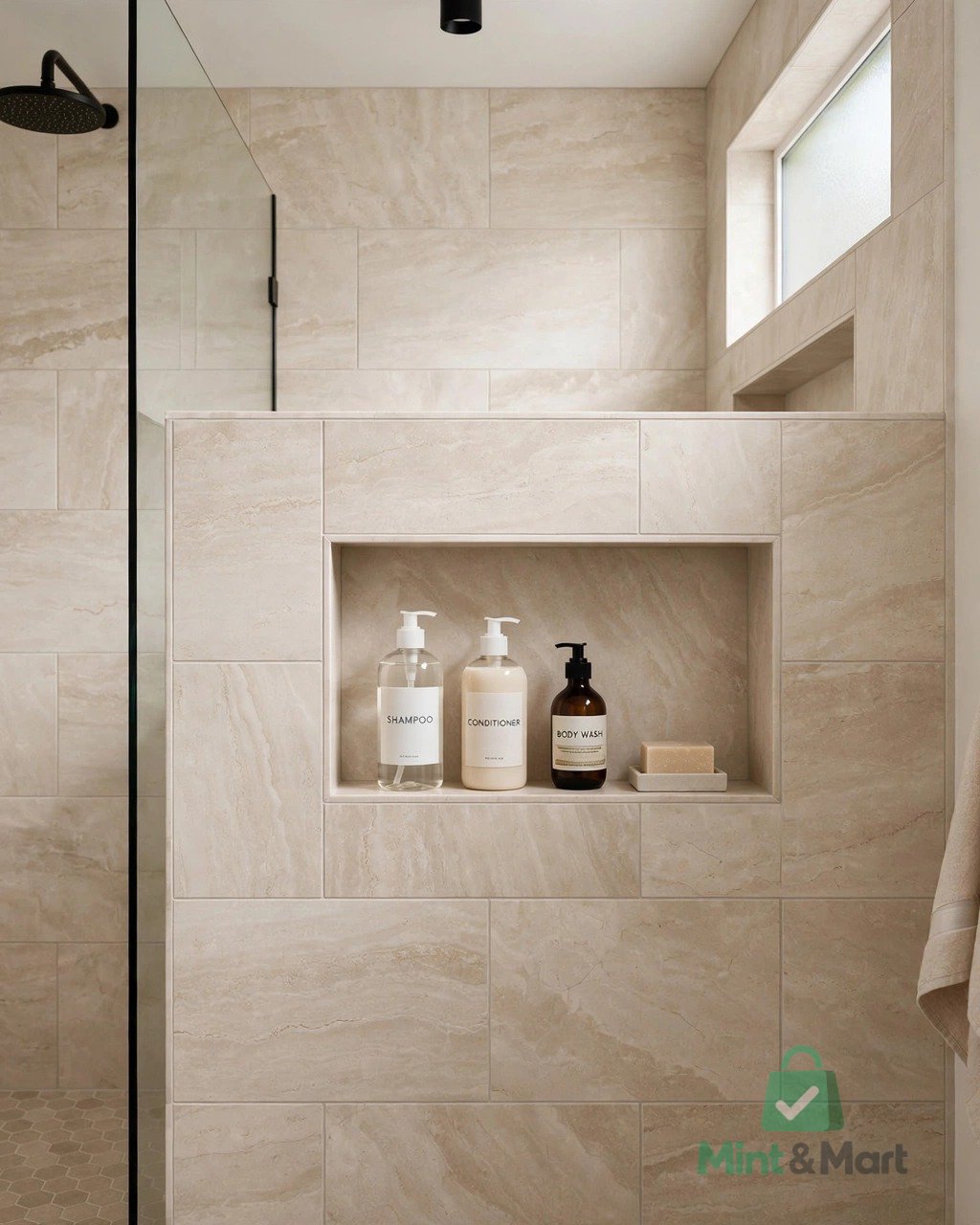
9. Create a Dedicated Shower Storage Zone
Shampoo bottles scattered around the shower floor make the space harder to clean and harder to use.
Choose one storage system rather than several competing ones.
Depending on the shower, that could be:
- a wall-mounted caddy
- a corner shelf
- a tension-pole organizer
- a built-in niche
If you are remodeling, recessed niches can provide storage without protruding into the shower. Built-in niches are also among the storage approaches highlighted in recent 2026 bathroom design examples. Houzz
Keep only the products currently in use inside the shower. Store unopened replacements elsewhere.
10. Use a Small Rolling Cart When Fixed Storage Is Not Possible
A slim rolling cart can work surprisingly well in a rental or a bathroom without sufficient cabinetry.
It can hold toiletries, towels, toilet paper, or hair tools and can be moved when you need to clean.
But check the walkway first.
A cart that constantly needs to be pushed aside is not solving a storage problem—it is creating another one.
Best for: Bathrooms with a narrow unused gap.
Skip it if: It reduces comfortable walking space or prevents doors and drawers from opening fully.
11. Keep Everyday Sink Items on One Small Tray
Not every item needs to disappear into a cabinet.
If you use something several times a day, a small countertop tray can be more practical than constantly putting it away.
Use it for only the true daily essentials—for example:
- hand soap
- one skincare product
- a frequently used grooming item
The tray creates a visual boundary. When products begin spilling outside it, that is a useful signal that the countertop has become storage rather than workspace.
12. Use Open Shelves for Larger, Easy-to-Identify Items
Open shelving works best when the contents are simple and visually easy to understand.
Good candidates include:
- folded towels
- toilet paper
- a small basket of washcloths
- frequently used bath products
Tiny products are usually better behind doors or inside drawers.
That distinction matters. Open shelving can make everyday items easy to reach, but too many small containers can quickly make a bathroom look more cluttered rather than less.
13. Give Each Person a Personal Storage Bin
In shared bathrooms, organizing by product category is not always the easiest system.
Instead, give each person a small drawer, bin, or basket for personal toiletries.
This removes the need to sort through several people’s products every morning and makes it easier to return things to the correct place.
Family members can still share common categories such as:
- toilet paper
- towels
- hand soap
- cleaning supplies
Personal care items stay separate.
14. Move Backup Products Out of Prime Bathroom Storage
One of the easiest ways to create bathroom storage requires no new organizer at all.
Remove duplicates.
If five unopened shampoo bottles occupy the cabinet beside the sink, they are taking space away from products you actually use every day.
Create one backstock area for unopened:
- soap
- toothpaste
- shampoo
- toilet paper
- skincare refills
In a very small bathroom, that area may be in a nearby linen closet rather than inside the bathroom.
This keeps the bathroom’s most accessible storage focused on current-use items.
15. Use Wall-Mounted Storage When Floor Space Is the Real Problem
When a bathroom is truly small, adding another piece of furniture usually makes circulation worse.
Look upward instead.
Wall-mounted options can include:
- shallow cabinets
- floating shelves
- toothbrush holders
- towel hooks
- narrow storage rails
The goal is not to cover every wall. It is to move a few frequently used items off the counter or floor.
That is usually more useful than trying to maximize storage capacity everywhere.
What Are Some Clever Storage Ideas for a Small Bathroom?
The most effective small-bathroom storage ideas use vertical surfaces and overlooked spaces instead of adding bulky floor furniture.
Start with:
- the inside of vanity doors
- the wall above the toilet
- unused wall space near the vanity
- shallow drawers
- the area around under-sink plumbing
- the back of the bathroom door
Then remove backup products that do not need to live in the bathroom.
A small bathroom often needs fewer things stored more intelligently, not simply more organizers.
Which Bathroom Items Deserve the Easiest-to-Reach Storage?
If you are deciding what belongs in your prime storage areas, start with the items that support everyday bathroom routines.
For many households, that means these ten basic categories:
- toilet paper
- hand soap
- toothbrushes and toothpaste
- hand towels
- bath towels
- shower products
- daily skincare
- everyday grooming supplies
- frequently needed hygiene products
- basic bathroom cleaning supplies
That does not mean all ten categories belong on the countertop.
The question is frequency.
A toothbrush may deserve eye-level storage. Extra bath towels may be fine on a higher shelf. Cleaning supplies may belong under the sink or in another safe, appropriate location.
What Bathroom Storage Ideas Are Showing Up in 2026?
Current 2026 bathroom design coverage points toward storage that is integrated into the room rather than added as visible clutter.
Recent Best of Houzz examples feature vertical countertop towers, full-height cabinetry, pullouts, built-in niches, open shelves used selectively, and hooks placed close to where items are needed. Some custom cabinets also integrate electrical outlets so grooming devices can be stored and charged out of sight. Houzz
That does not mean every bathroom needs custom cabinetry.
The practical lesson is simpler:
Use storage that reduces steps in your routine while keeping counters and walkways clear.
A $15 hook in the right location may improve a bathroom more than an expensive cabinet installed where nobody naturally reaches for things.
What Usually Doesn’t Work in a Small Bathroom?
Adding more storage is not automatically an improvement.
A few approaches commonly create new problems:
Oversized countertop organizers
They store plenty but eliminate useful sink space.
Very deep baskets
Small products disappear underneath one another.
Too many open shelves
They can turn storage into visible clutter.
Large freestanding cabinets
They may add capacity while making a compact room harder to move through.
Multiple organizers for the same category
If skincare is scattered across a drawer, shelf, cabinet, and countertop, the room may technically be organized but still be inconvenient.
Buying organizers before measuring
Always measure width, depth, height, plumbing, door swing, and drawer clearance first.
A Simple Bathroom Storage Decision Guide
Before adding anything, identify the actual problem.
| Your problem | Try this first |
|---|---|
| Countertop is crowded | Drawer dividers or medicine cabinet |
| Can’t find small items | Shallow divided storage |
| Deep cabinet is hard to use | Pull-out organizer |
| Under-sink space is wasted | Modular storage around plumbing |
| No floor space | Wall-mounted storage |
| Towels end up everywhere | Hooks near point of use |
| Shower products cover the floor | One dedicated shower storage system |
| Cabinet is full of unopened products | Create a separate backstock zone |
| Several people share the bathroom | Personal bins or drawers |
| Rental has little built-in storage | Removable shelves, hooks, or slim cart |
This is the part worth deciding before shopping for storage products.
The best organizer is not necessarily the one that holds the most. It is the one that removes a specific friction point from the way you already use the room.
The Bottom Line
Creative bathroom storage does not require filling every empty wall or buying a matching set of organizers.
Start with what you reach for every day. Give those items the best locations. Use vertical space and hidden surfaces when the room is small, keep backups away from prime storage, and choose storage based on the problem you are actually trying to solve.
When bathroom storage follows your daily routine, items become easier to find, countertops stay more usable, and even a compact bathroom can work much better—without needing to store more than it really should.